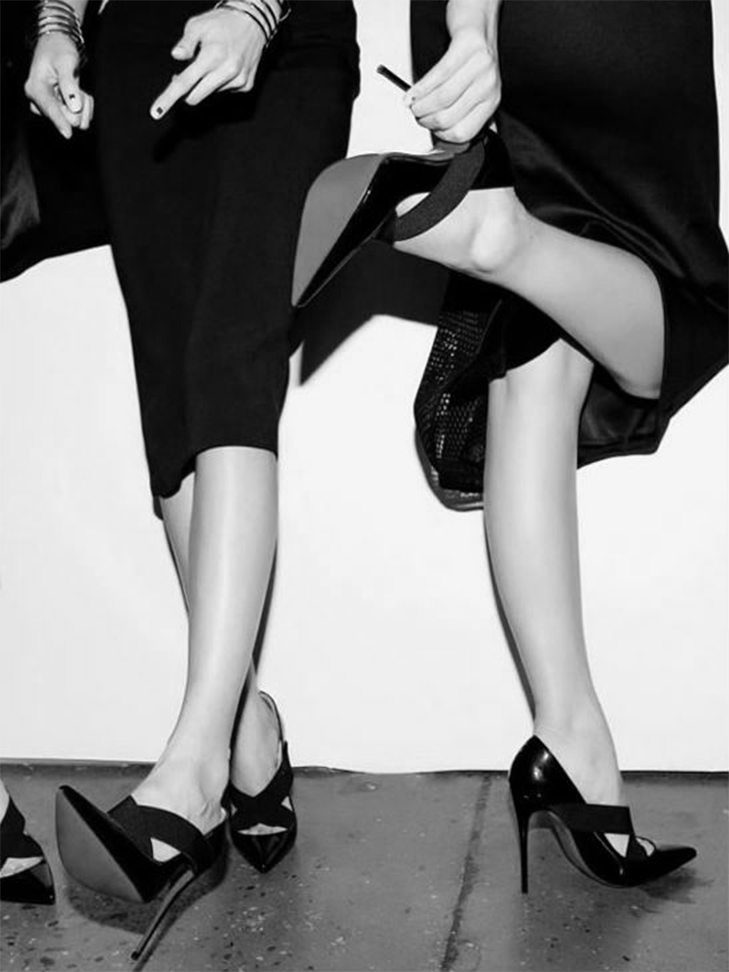
Thanks to the sensational clip "Exhibit" by one well-known band from St. Petersburg, now many people know that "Lobutens" (more precisely "Louboutins") are shoes with a red sole. However, as it turns out in practice, not all shoes with a red sole are the famous Louboutins.
Christian Louboutin created one of the most iconic trade marks of the 21st century. Christian Louboutin's shoes are not just shoes; they are the epitome of fashion, a status symbol, and a work of art whose design is protected by law. They are best known for their iconic red soles, which are not only a distinctive feature of the brand but are also legally protected as a trade mark.
Christian Louboutin v. YSL
Therefore, when the competing brand Yves Saint-Laurent (YSL) introduced a new model of monochrome red shoes with red soles in its spring collection in 2011, Christian Louboutin was able to exercise his trade mark rights for the first time and filed a lawsuit against YSL in the U.S. District Court for the Southern District of New York (Christian Louboutin S.A. v. Yves Saint Laurent America, Inc., S.D.N.Y. 2011).
The court was faced with a difficult task: to decide the fate of Christian Louboutin's monopoly on the red soles that women have come to love. According to The Wall Street Journal, many women attended the court hearing wearing Louboutins, showcasing their red soles and expressing their support for the designer. However, this display did not sway Judge Marrero, and the court of first instance denied the lawsuit.
The arguments against Louboutin's lawsuit revolved around the question of whether it is possible to establish a monopoly on color in design. The court found that Christian Louboutin failed to prove that the use of red color was worthy of trade mark protection because the color serves decorative and aesthetic functions in the fashion industry, which are necessary for healthy competition (the doctrine of "aesthetic functionality"). In its decision, the Court also referred to the position developed in the Qualitex case, which states that a color can be protected only if it serves as a distinctive feature of a product and identifies its origin without performing any function (Qualitex Co. v. Jacobson Prods. Co.). Therefore, the red color in the soles of Louboutin shoes does not possess the necessary characteristics for protection as a trade mark, as it performs other functions, such as contributing to the allure of the product, and its protection as a trade mark would prohibit competitors from using the color in their products, hindering the development of creativity and artistic freedom in the fashion industry. Thus, the court did not recognize Christian Louboutin's exclusive right to use a red sole in the design of his shoes.
All of Louboutin's arguments were properly addressed in the decision of the U.S. Court of Appeals for the Second Circuit, which disagreed with the decision of the lower court.
As we know, a trade mark is designed to individualize a product in such a way that a consumer who sees a trade mark on a product can automatically identify who owns that product. For example, if a customer sees a T-shirt or a dress with the H&M label, they obviously understand that the clothing is produced by H&M. Thus, the ultimate goal of any trade mark is to identify the origin of the product.
In the fashion industry, the purpose of a trade mark is to identify a product as belonging to a particular brand or designer. From a psychological perspective, if a product has the label of an elite brand (such as Valentino), customers are more likely to pay more for it because it is a recognizable and prestigious piece of clothing. Most people would not pay $2,000 for a single pair of shoes unless they were confident that others would recognize that they were wearing $2,000 shoes.
As practice shows, in the fashion industry, color or color combination is quite often used precisely to determine the brand affiliation and origin of the product. So, for example, the jewelry giant Tiffany & Co, who spoke in support of Louboutin, registered as a trade mark the pale blue color, which it uses for packaging of products (the famous blue boxes of Tiffany with a white bow). The British fashion house Burberry also registered its signature "plaid", and the Italian brand Gucci — its easily recognizable green and red stripe.
All of the above constitutes the basis of the so-called "second meaning concept", according to which a trade mark acquires protectability if it is associated in the consumer's mind with a specific product and its manufacturer, rather than with a product of a certain class in general. The first-instance court did not take into account that the Louboutin trade mark had acquired such a second meaning.
The Court of Appeal noted that, while the red sole did not initially indicate the origin of the product, Christian Louboutin's consistent and continuous use of the red sole in his shoe designs has become a symbol of his brand, making the red sole a recognizable trade mark that has become associated with Louboutin shoes. As a result, consumers are more likely to purchase Louboutin shoes when they see a red sole, as it signifies that the shoes are designed by Christian Louboutin.
The Court of Appeal rejected the concept of "aesthetic functionality" in this particular dispute and recognized the right of protection for the Louboutin trade mark. The value of the court's decision lies in the fact that it provides specific criteria for applying the concept of functionality. Accordingly, this concept should be applied when: (1) the design feature is essential for the purpose of the product, (2) the design feature affects the cost or quality of the product, and (3) granting protection to such a design feature could significantly restrict competition. In these cases, the designation would not be eligible for trade mark protection.
As a result of this detailed analysis, the Court of Appeal confirmed the validity of Christian Louboutin's trade mark, but limited its application. According to the court, only those shoes whose color contrasts with the red sole have acquired distinctiveness, and the trade mark will apply to them. The court even noted that when celebrities wear Louboutins, they are recognized by their contrasting soles. However, there was no evidence in the case file that all-red shoes have the same distinctiveness and are associated with Louboutins.
This circumstance allowed the American court to make a Solomon's decision: to confirm the exclusive right of Louboutin to produce contrasting shoes with red soles, and to allow YSL to continue producing monochrome shoes with red soles. The fashion giants were satisfied with this decision, and despite their initial claims, each of them proudly declared that they had achieved their goal in court.
Christian Louboutin v. ZARA
While all the attention was focused on the battle of the grandees in the American court, few people noticed that at the same time, a similar lawsuit was filed by Louboutin in France against the company ZARA due to the fact that the Spanish giant of "fast fashion" released a model of sandals too similar and also used a red sole in the design.
Louboutin accused ZARA of "counterfeiting and unfair competition". However, this lawsuit did not end well for Louboutin. The French Court of Appeal ruled in favor of ZARA, arguing that Louboutin's trade mark was too "vague" because the specific shade of red was not specified when registering the designer shoe's trade mark.
Moreover, the court ruled that the plaintiff had not proven the risk of misleading consumers in such a way that they could confuse these two brands and their shoes. The court even ordered Louboutin to pay ZARA compensation of 2,500 euros.
Susan Scafidi, a professor at the Fashion Law Institute in New York, agrees that in cases like this, the key question is whether the disputed product misleads consumers, not only during the shopping experience and the actual selection of the product, but also during the perception of the flashing red soles on the street. Perhaps due to the significant price difference in the case of ZARA sandals, the court believed that there was no confusion in the minds of consumers.
However, according to Professor Scafidi, this decision by the French court should not be interpreted as allowing other participants in the fashion market to produce shoes with red soles. Firstly, this decision is only valid in France, and secondly, based on the court's reasoning, Christian Louboutin has updated his French trade mark application to specify a specific shade of red in the Pantone system (18-1663TP, Chinese Red). Therefore, his claim to the red sole has not been completely defeated but rather limited.
Despite the fact that ZARA emerged victorious from this dispute, shoes with red soles were no longer commonly found among its products.
Christian Louboutin v. Van Haren
The unfortunate defeat in the case against ZARA did not prevent Christian Louboutin from filing a claim for trade mark infringement with the Hague District Court in 2013. This time, Louboutin demanded that the violator, the Dutch shoe brand Van Haren, not sell stylized shoes with red soles from their joint collection with American actress Halle Berry "5th Avenue by Halle Berry". The court found a trade mark infringement and ordered the Dutch brand to stop producing black and blue shoes with red soles, as it agreed that the public associates the red sole with a specific brand (i.e., Christian Louboutin), and the shoes produced by Van Haren thus mislead most people. The Brussels Court of Appeal confirmed that the red sole is a distinctive and recognizable feature of the Christian Louboutin brand and upheld the decision against Van Haren.
Christian Louboutin's trade mark is protected in many countries, including the United Kingdom, Japan, France, Australia, and Russia, which suggests that the red-soled shoes will continue to be the subject of legal battles. Interestingly, not long ago, the active fighter against copying and imitation was himself accused of plagiarism. The famous TV presenter Ksenia Sobchak noticed a striking resemblance between Louboutin's work and the original design of Alexander Siradekian, a renowned Russian shoe designer known for his iconic fringed pumps.
However, Russian designers, unlike their Western counterparts, are not yet as active in protecting their rights, despite the fact that since 2014, Russian law has also provided for the legal protection of trade marks for elements such as shape, packaging, or color, provided that such elements or combinations of elements have acquired distinctiveness as a result of their use prior to the filing of a trade mark application. In this sense, it is difficult to argue with Ksenia Sobchak that the elegant fringe above the heel evokes a strong association with the ALEKSANDERSIRADEKIAN brand, but that is a different story.
Christian Louboutin created one of the most iconic trade marks of the 21st century. Christian Louboutin's shoes are not just shoes; they are the epitome of fashion, a status symbol, and a work of art whose design is protected by law. They are best known for their iconic red soles, which are not only a distinctive feature of the brand but are also legally protected as a trade mark.
Christian Louboutin v. YSL
Therefore, when the competing brand Yves Saint-Laurent (YSL) introduced a new model of monochrome red shoes with red soles in its spring collection in 2011, Christian Louboutin was able to exercise his trade mark rights for the first time and filed a lawsuit against YSL in the U.S. District Court for the Southern District of New York (Christian Louboutin S.A. v. Yves Saint Laurent America, Inc., S.D.N.Y. 2011).
The court was faced with a difficult task: to decide the fate of Christian Louboutin's monopoly on the red soles that women have come to love. According to The Wall Street Journal, many women attended the court hearing wearing Louboutins, showcasing their red soles and expressing their support for the designer. However, this display did not sway Judge Marrero, and the court of first instance denied the lawsuit.
The arguments against Louboutin's lawsuit revolved around the question of whether it is possible to establish a monopoly on color in design. The court found that Christian Louboutin failed to prove that the use of red color was worthy of trade mark protection because the color serves decorative and aesthetic functions in the fashion industry, which are necessary for healthy competition (the doctrine of "aesthetic functionality"). In its decision, the Court also referred to the position developed in the Qualitex case, which states that a color can be protected only if it serves as a distinctive feature of a product and identifies its origin without performing any function (Qualitex Co. v. Jacobson Prods. Co.). Therefore, the red color in the soles of Louboutin shoes does not possess the necessary characteristics for protection as a trade mark, as it performs other functions, such as contributing to the allure of the product, and its protection as a trade mark would prohibit competitors from using the color in their products, hindering the development of creativity and artistic freedom in the fashion industry. Thus, the court did not recognize Christian Louboutin's exclusive right to use a red sole in the design of his shoes.
All of Louboutin's arguments were properly addressed in the decision of the U.S. Court of Appeals for the Second Circuit, which disagreed with the decision of the lower court.
As we know, a trade mark is designed to individualize a product in such a way that a consumer who sees a trade mark on a product can automatically identify who owns that product. For example, if a customer sees a T-shirt or a dress with the H&M label, they obviously understand that the clothing is produced by H&M. Thus, the ultimate goal of any trade mark is to identify the origin of the product.
In the fashion industry, the purpose of a trade mark is to identify a product as belonging to a particular brand or designer. From a psychological perspective, if a product has the label of an elite brand (such as Valentino), customers are more likely to pay more for it because it is a recognizable and prestigious piece of clothing. Most people would not pay $2,000 for a single pair of shoes unless they were confident that others would recognize that they were wearing $2,000 shoes.
As practice shows, in the fashion industry, color or color combination is quite often used precisely to determine the brand affiliation and origin of the product. So, for example, the jewelry giant Tiffany & Co, who spoke in support of Louboutin, registered as a trade mark the pale blue color, which it uses for packaging of products (the famous blue boxes of Tiffany with a white bow). The British fashion house Burberry also registered its signature "plaid", and the Italian brand Gucci — its easily recognizable green and red stripe.
All of the above constitutes the basis of the so-called "second meaning concept", according to which a trade mark acquires protectability if it is associated in the consumer's mind with a specific product and its manufacturer, rather than with a product of a certain class in general. The first-instance court did not take into account that the Louboutin trade mark had acquired such a second meaning.
The Court of Appeal noted that, while the red sole did not initially indicate the origin of the product, Christian Louboutin's consistent and continuous use of the red sole in his shoe designs has become a symbol of his brand, making the red sole a recognizable trade mark that has become associated with Louboutin shoes. As a result, consumers are more likely to purchase Louboutin shoes when they see a red sole, as it signifies that the shoes are designed by Christian Louboutin.
The Court of Appeal rejected the concept of "aesthetic functionality" in this particular dispute and recognized the right of protection for the Louboutin trade mark. The value of the court's decision lies in the fact that it provides specific criteria for applying the concept of functionality. Accordingly, this concept should be applied when: (1) the design feature is essential for the purpose of the product, (2) the design feature affects the cost or quality of the product, and (3) granting protection to such a design feature could significantly restrict competition. In these cases, the designation would not be eligible for trade mark protection.
As a result of this detailed analysis, the Court of Appeal confirmed the validity of Christian Louboutin's trade mark, but limited its application. According to the court, only those shoes whose color contrasts with the red sole have acquired distinctiveness, and the trade mark will apply to them. The court even noted that when celebrities wear Louboutins, they are recognized by their contrasting soles. However, there was no evidence in the case file that all-red shoes have the same distinctiveness and are associated with Louboutins.
This circumstance allowed the American court to make a Solomon's decision: to confirm the exclusive right of Louboutin to produce contrasting shoes with red soles, and to allow YSL to continue producing monochrome shoes with red soles. The fashion giants were satisfied with this decision, and despite their initial claims, each of them proudly declared that they had achieved their goal in court.
Christian Louboutin v. ZARA
While all the attention was focused on the battle of the grandees in the American court, few people noticed that at the same time, a similar lawsuit was filed by Louboutin in France against the company ZARA due to the fact that the Spanish giant of "fast fashion" released a model of sandals too similar and also used a red sole in the design.
Louboutin accused ZARA of "counterfeiting and unfair competition". However, this lawsuit did not end well for Louboutin. The French Court of Appeal ruled in favor of ZARA, arguing that Louboutin's trade mark was too "vague" because the specific shade of red was not specified when registering the designer shoe's trade mark.
Moreover, the court ruled that the plaintiff had not proven the risk of misleading consumers in such a way that they could confuse these two brands and their shoes. The court even ordered Louboutin to pay ZARA compensation of 2,500 euros.
Susan Scafidi, a professor at the Fashion Law Institute in New York, agrees that in cases like this, the key question is whether the disputed product misleads consumers, not only during the shopping experience and the actual selection of the product, but also during the perception of the flashing red soles on the street. Perhaps due to the significant price difference in the case of ZARA sandals, the court believed that there was no confusion in the minds of consumers.
However, according to Professor Scafidi, this decision by the French court should not be interpreted as allowing other participants in the fashion market to produce shoes with red soles. Firstly, this decision is only valid in France, and secondly, based on the court's reasoning, Christian Louboutin has updated his French trade mark application to specify a specific shade of red in the Pantone system (18-1663TP, Chinese Red). Therefore, his claim to the red sole has not been completely defeated but rather limited.
Despite the fact that ZARA emerged victorious from this dispute, shoes with red soles were no longer commonly found among its products.
Christian Louboutin v. Van Haren
The unfortunate defeat in the case against ZARA did not prevent Christian Louboutin from filing a claim for trade mark infringement with the Hague District Court in 2013. This time, Louboutin demanded that the violator, the Dutch shoe brand Van Haren, not sell stylized shoes with red soles from their joint collection with American actress Halle Berry "5th Avenue by Halle Berry". The court found a trade mark infringement and ordered the Dutch brand to stop producing black and blue shoes with red soles, as it agreed that the public associates the red sole with a specific brand (i.e., Christian Louboutin), and the shoes produced by Van Haren thus mislead most people. The Brussels Court of Appeal confirmed that the red sole is a distinctive and recognizable feature of the Christian Louboutin brand and upheld the decision against Van Haren.
Christian Louboutin's trade mark is protected in many countries, including the United Kingdom, Japan, France, Australia, and Russia, which suggests that the red-soled shoes will continue to be the subject of legal battles. Interestingly, not long ago, the active fighter against copying and imitation was himself accused of plagiarism. The famous TV presenter Ksenia Sobchak noticed a striking resemblance between Louboutin's work and the original design of Alexander Siradekian, a renowned Russian shoe designer known for his iconic fringed pumps.
However, Russian designers, unlike their Western counterparts, are not yet as active in protecting their rights, despite the fact that since 2014, Russian law has also provided for the legal protection of trade marks for elements such as shape, packaging, or color, provided that such elements or combinations of elements have acquired distinctiveness as a result of their use prior to the filing of a trade mark application. In this sense, it is difficult to argue with Ksenia Sobchak that the elegant fringe above the heel evokes a strong association with the ALEKSANDERSIRADEKIAN brand, but that is a different story.