"The perfumer works miracles, people think him half a wizard—so much the better. What he alone knew, was that his art was a craft like any other, and it was in this that he took his pride"1.
Perfumery has always been an important part of human culture. The perfumery industry, generally considered quite closed and conservative, has been developing rapidly in recent years (even flirting with artificial intelligence). After the pandemic, we came to value our sense of smell more, which also drove growing interest in aromatherapy and scents that affect mood and emotional state.
Creating a fragrance requires significant creative effort, skill, and talent, and the huge teams behind perfume brands are constantly chasing unique, one-of-a-kind scents. This makes the question of protecting a fragrance all the more pressing. The appearance of counterfeit products, fakes, and imitations obviously reduces consumer demand for the original.
That is exactly why it's important for perfume brands to understand what legal tools exist to protect a fragrance, which ones fit their particular product, and how to actually secure that protection. In this article, we attempt to analyze which legal mechanisms stand guard over a perfumer's interests.
Perfume and Trade Marks
The trade mark is a perfumer's main weapon in the fight against counterfeits. What can be registered as a trademark is the name and logo, the label, and also the shape of the bottle — provided the shape is not merely functional but also has distinctive character and essentially performs the function of a trade mark: giving the consumer an idea of the product's source.
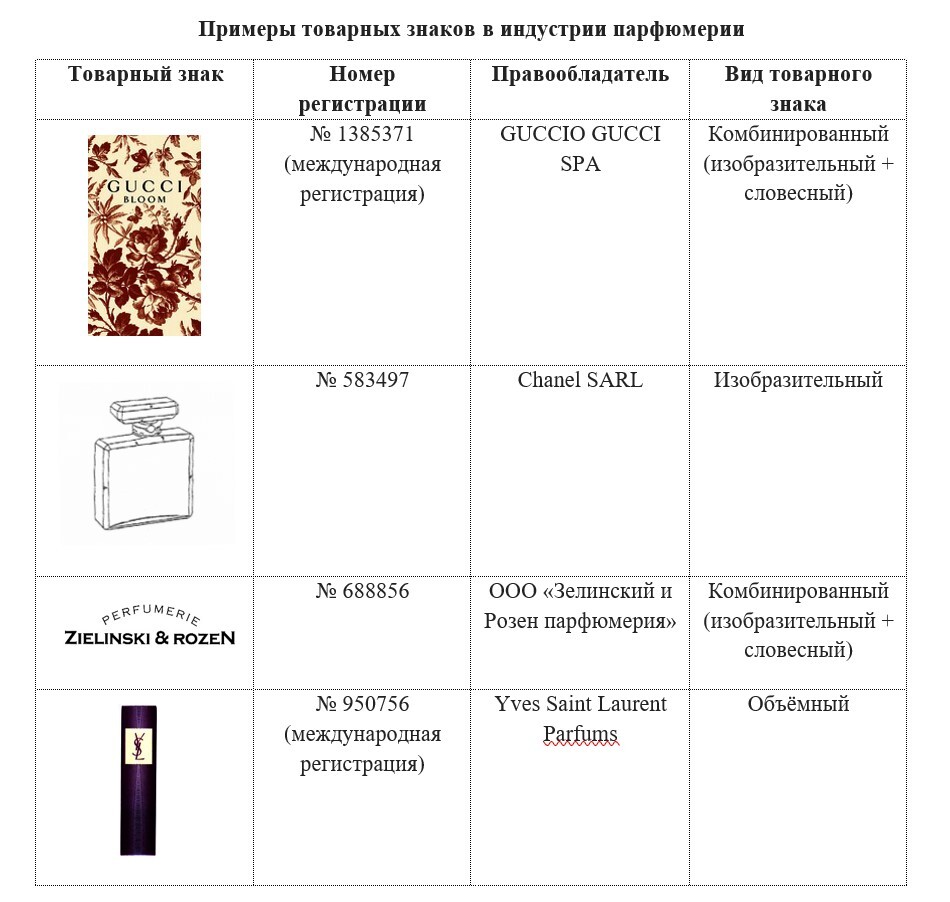
Registering the name, logo, and bottle shape as trade marks gives the rights holder fairly powerful tools to fight dishonest imitators. If a competitor releases a similar perfume to one already well known on the market (and it's usually well-known, popular scents that get copied and imitated), how can they signal to potential buyers what the perfume resembles, if they can't use identical or confusingly similar names, logos, and packaging?
However, a trade mark won't help if the infringer uses the same scent (because they liked someone else's and don't want to develop their own) but doesn't mimic a particular brand or try to trade on its reputation — which often happens with smaller niche brands.
That's because the scent itself cannot be registered as a trade mark. Or rather, registration of an olfactory trademark is provided for under Russian law, but not for products like perfume. The relevant regulation (FIPS Order2) states that "perfume, by virtue of its purpose (a scenting agent), must by definition have some smell, and therefore the smell of perfume cannot serve as a means of individualizing it." Consequently, an olfactory trade mark can be registered if consumers have formed a strong association between a product or service and a specific smell that individualizes that product or service. Think, for example, of how Massimo Dutti stores smell.
Despite the growing popularity of scent marketing, only one olfactory trademark has ever been registered in Russia (Certificate No. 470375), protecting the smell of leather. Even so, it's hard to conclude that this trademark was actually registered as an olfactory one. In the trademark's description, it's listed as a combined mark, and the protected subject matter is given as the phrase "Leather Scent" together with a corresponding image (rather than the scent itself).
Thus, trade marks can only provide legal protection for the external features that individualize perfume products (packaging, logo, label, bottle shape) — not for the scent itself. In most cases that's enough, but there remain situations where trade marks simply cannot help.
For example, at one point shopping centers were actively offering so-called "loose" or "bulk" perfume — these are the same "copies" and "dupes," just without a label or packaging. Often the seller will simply tell the customer verbally that they have a scent similar to Chanel No. 5 or Dior J'adore. Whether such use would be found to infringe trade mark rights is a contentious question. After all, the seller isn't claiming it's the original, and isn't using the logo, packaging, or label. They mention the names of specific fragrances more for informational purposes, to describe what the product they're offering smells like. Such use is obviously not in the interest of the perfume brands whose analogs are being sold in bulk. However, the legal uncertainty over whether such use would infringe trade mark rights has most likely discouraged perfume brands from trying to defend their interests in Russian courts.
An Israeli court, however, has had to carefully analyze this exact question over the past six years. It recently issued its ruling in the case brought by a group of perfume companies (including L'Oréal, Revlon, Ralph Lauren Polo, Chloé, and Armani) against Oil De Lamor. The court ruled that referencing someone else's trademarks is permissible, so long as it does not mislead consumers as to the source of the product.
In this case, the court concluded that Oil De Lamor's use of the perfume brands' trade marks — the company produced cheaper analogs and used the names of well-known brands but added the word "compatible" — was a good-faith act that was not intended to mislead consumers. The court also emphasized that the plaintiffs were trying to expand the scope of protection granted to trade marks, essentially trying to protect the scent itself rather than the brand.
Can a Perfume Be Patented?
As it turns out, yes. For example, the company Coty Inc. obtained a patent (No. 2575778) for the invention "Perfume," whose claims described in considerable detail the process for producing the perfume and various ways of embodying the formula in a fragrance.
Obtaining an invention patent, however, is a fairly expensive and labor-intensive procedure. The applicant must prove inventive step, industrial applicability, and novelty. It's also important to remember that the term of protection for inventions cannot exceed 20 years. This means that once a patent is granted (which requires disclosing and publishing the perfume's formula), the invention will enter the public domain after 20 years and can then be used freely by third parties. This limited term of protection often runs counter to the interests of the perfume industry. Famous perfumes (for example, Chanel No. 5, Miss Dior, YSL Black Opium) don't go out of style for decades, which creates a need to protect them for a much longer period.
In addition, artificial intelligence is now helping create so-called "dupes." Algorithms analyze the original fragrance formula and suggest how ingredients in the composition can be swapped out so that the scent remains similar while not infringing the patent's claims.
Design patents (industrial designs) can also protect the appearance of a bottle or label, provided they are new and original.

However, relying solely on a design patent is unwise, since legal protection for industrial designs is granted for a maximum of 25 years. If a bottle and its packaging are used for a sufficiently long time and intensively enough that they begin to perform the function of a trade mark (that is, become associated with a specific manufacturer), it makes sense to also try to register them as a trademark.
Or Could You Just Keep the Formula a Secret?
A third option, also frequently used in the industry, is to try to keep the perfume's scent a secret. In this way, a perfume can be protected under Article 1465 of the Russian Civil Code as know-how (a trade secret), provided its composition/formula has commercial value precisely because it is unknown to third parties, and provided third parties have no free access to that information. However, if the composition of the perfume becomes known to third parties, the know-how rights cease to apply.
That said, perfumery specialists can often determine what goes into a fragrance's composition using a special device — a mass spectrometer, which automatically separates mixtures into individual components and identifies those substances. So the effectiveness of know-how as a tool in a perfumer's arsenal is also questionable.
Perfume and Copyright
Copyright protects works created through creative labor and expressed in an objective form. When we talk about copyright, what first comes to mind are literary works, music, paintings and graphic art, films, or even video games. But can the scent of a perfume be protected by copyright, given that the process of creating a fragrance undoubtedly also requires creative labor?
In the process of creating a fragrance, the perfumer contributes not only labor but also something that cannot be reduced to mere technical operations or logical deduction — they express certain aspects of their own personality in the final result. And no one but that person could arrive at an identical result, even if placed in the exact same starting conditions.
Neither in Russia nor abroad is there a settled position among lawmakers and courts on this question. There is also no established Russian case law on granting copyright protection to a perfume's scent. At the same time, in academic circles there is often opposition to granting copyright protection to a perfume's scent, on the grounds that supposedly (1) perfume is not expressed in an objective form, and (2) perfume cannot be considered a "work" in the copyright sense.
Similar arguments against copyright protection for a perfume's scent were also set out in a French court ruling concerning the Christian Dior Dune fragrance3. However, in the Netherlands in 2006, one of the first rulings was issued that extended copyright protection to the scent of a Lancôme perfume4.
The French company Lancôme filed suit against the Dutch company Kecofa, citing trade mark infringement. Kecofa was selling a perfume called Treasure, similar to Lancôme's Trésor. The court of first instance dismissed the claim, finding that Kecofa's perfume was significantly cheaper and did not create consumer confusion.
Lancôme then took a different approach and filed a new claim, this time alleging infringement of copyright in the perfume's scent. The court sided with Lancôme and found that Kecofa had infringed its rights, reaching several important conclusions in its ruling:
- A perfume's scent has an objective form, since it is perceived by the senses — specifically, by smell;
- A perfume's scent and the liquid containing that scent are two different objects, much like a sheet of paper is not itself a copyrightable object, whereas the content of a book is;
- Perfumes containing entirely different ingredients but having the same smell may indicate copyright infringement, whereas perfumes with an identical formula but different scents would not indicate infringement.
This ruling revived the debate over whether perfume can be protected by copyright.
We believe that Russian law does not prevent granting copyright protection to a scent: a fragrance is expressed in an objective form and can be perceived by the senses, and it can also be considered a "work" (since the list of works under the Russian Civil Code is not closed/exhaustive). We hope that Russian courts will adopt a similar approach, which would allow for more effective protection of the rights and interests of perfume manufacturers.
What About Unfair Competition?
Sometimes bad faith is obvious, yet proving infringement of specific intellectual property rights (trade marks, industrial designs, inventions) is quite difficult. For example, a name might seem similar but not confusingly similar, and the packaging and label might not explicitly copy or imitate someone else's product — yet still be designed in such a way that, taken together, they could mislead consumers as to the source of the goods.
In such cases, it makes sense to turn to the Federal Law "On the Protection of Competition," which, in addition to a general prohibition on unfair competition, contains a more specific prohibition on unfair competition involving the creation of confusion (Article 14.6). Before the FAS or in court, however, one would have to prove that the companies operate in the same market and are competitors (which is not as simple task as it might seem at first glance, especially when prices differ significantly).
Consequently, perfume brands have the entire arsenal of tools offered by intellectual property law at their disposal. The choice of a specific strategy depends on the situation. Often, though, the optimal strategy is a combination of several approaches (for example, first filing a design-patent application for the packaging and label while it is still new, and then registering them as a trade mark later, once that same design has instead gained recognition through prolonged, intensive use) — allowing for the most effective protection of rights and interests in the event of infringement.
Footnotes:
- Süskind, Patrick. Perfume: The Story of a Murderer / Patrick Süskind; [translated from German by Ella Vladimirovna Vengerova]. — St. Petersburg: Azbuka-klassika, 2005. — 313 pp.
- Order of the Federal State Budgetary Institution FIPS No. 12 of January 20, 2020 (as amended March 25, 2022), "On Approval of the Guidelines for Carrying Out Administrative Procedures and Actions Within the Framework of Providing the State Service for the State Registration of a Trademark, Service Mark, Collective Mark, and the Issuance of Certificates for a Trademark, Service Mark, Collective Mark, and Their Duplicates."
- Cour de Cassation, Ruling No. 1006, June 13, 2006, Nejla X v. Soc. Haarmann & Reimer. URL: https://www.legifrance.gouv.fr/juri/id/JURITEXT000007056062.
- Hoge Raad (Dutch Supreme Court), June 16, 2006, LJN AU8940, Kecofa/Lancôme. URL: https://www.dekuzu.com/dl/docs/ECLI-NL-HR-2006-AU8940.pdf