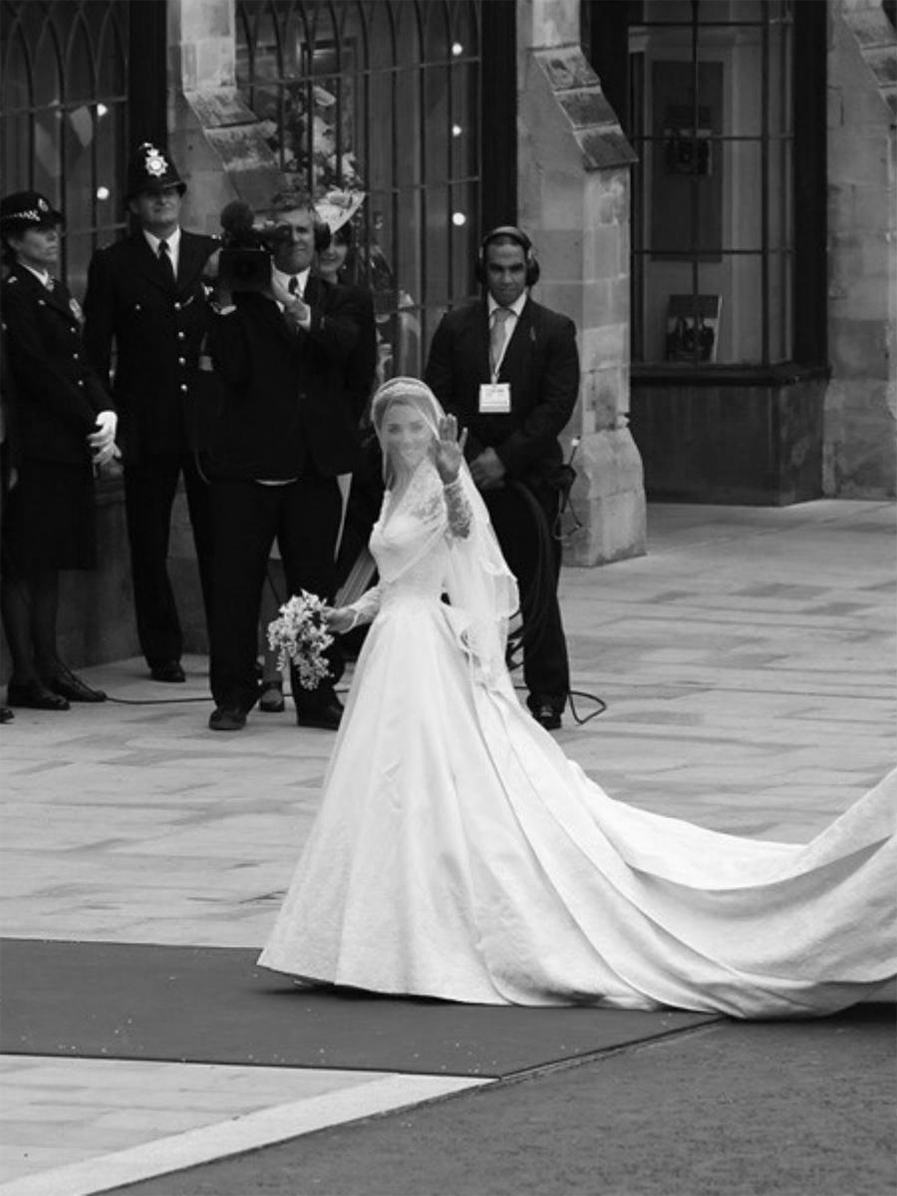
On April 29, 2011, the fairy tale of Cinderella came to life, and a simple girl named Kate became the Duchess of Cambridge. The entire world eagerly watched the live broadcast of this wedding. The groom's regal appearance, complete with a red coat adorned with personalized ribbons and awards, contrasted with the bride's elegant and feminine attire. There was no hint of flirtatiousness, vulgarity, or sex appeal. The bride's shoulders were covered with lace, her neckline was modest, and she had 58 buttons on her back. Even married women couldn't help but sigh in surprise and envy.
This stunning dress was created by Sarah Burton, the designer behind the Alexander McQueen fashion house.
After this momentous event, all the fashion tabloids, women's magazines, and the yellow press were eagerly discussing every detail of the wedding day, analyzing the patterns and meanings on the bride's dress.
And now, only in 2016, when Kate Middleton already had two charming children, her wedding dress again made news and this time in the legal community.
According to media reports, fashion designer Kristin Kendall filed a claim against the fashion house Alexander McQueen, indicating that Sarah Burton "stole" her design of Kate Middleton's wedding dress. The fashion designer claims that back in 2010, she sent her sketches of the dress to the royal family, and received a thank-you note for her participation. However, she was horrified to discover that the bride's dress was an exact replica of her sketches.
The Alexander McQueen fashion house does not recognize the claim, stating that they do not know Ms. Kendall, have not seen her sketches, and have not conducted any negotiations with her.
Does This Case Have Any Prospects From the Point of View of Russian Law?
The fundamental principles of Russian and English law coincide in terms of the grounds for liability and the need to prove the reality of the violation.
The author's rights are inalienable and arise from the moment of creation of the object of copyright. The author of a work has the right to transfer their exclusive rights (rights of use, reproduction, etc.) to any other person under a license agreement or an exclusive right transfer agreement.
In this situation, Ms. Kendall indicates that her work (the sketch) was used by the fashion house Alexander McQueen without any permission from her, meaning that there are no legal grounds for the use of her work by a third party.
The current legislation provides for various mechanisms for restoring violated copyrights, including the prohibition of use and the payment of compensation for the illegal use of a work. These methods are civil liability measures, and therefore, in order to satisfy such claims, it is necessary to prove a set of conditions that are legally required for liability.
A person who believes that their rights to a work (an object of copyright) have been violated will have to prove the following in court:
Was There Authorship?
First, Kristin Kendall must prove that the dress design was created by her own efforts. Any evidence that indicates the sketches were created by her and the date of creation will help her. For example, a recorded email from Kristin Kendall to participate in the sketch competition, along with the attached materials, can be used to justify the priority of her work.
Was There a Violation?
Secondly, Ms. Kendall, as the plaintiff, will have to prove that her exclusive rights to the dress design have indeed been infringed.
In the context of this dispute, the question will inevitably arise as to the extent to which Sarah Burton's design replicates or borrows elements from the designer's dress. The object of copyright cannot simply be the use of lace, a long train, or a low neckline. The law protects the authorship of an exclusive and unique combination of all the elements that create a specific dress, rather than individual elements. However, from the point of view of the Russian Court of Intellectual Property, the mere absence of novelty, uniqueness, and (or) originality of the result of intellectual activity does not mean that such a result was not created by creative work and, therefore, is not subject to copyright.
Therefore, when resolving the dispute, the court will need to establish that it was the designer's unique sketch that was fully embodied by Sarah Burton in Kate Middleton's wedding dress.
The element of fault is an integral part of the civil law violation. However, in Russian law, the plaintiff does not need to prove the perpetrator's guilt, as it is presumed (the presumption of guilt), and the burden of proving its absence lies with the defendant.
The fashion house Alexander McQueen can build its defense as follows:
According to Kristin Kendall, she sent her designs to the royal family back in 2010. In response, she received a letter expressing gratitude for her involvement. There were no further contacts between her and the Alexander McQueen fashion house. Therefore, if Miss Kendall claims that her designs were directly handed over to Sarah Burton by Miss Kate Middleton, it is possible that she was referring to the royal family. This means that in order to properly resolve the dispute, the court will have to establish that the future Duchess of Cambridge, upon receiving the sketch, passed it on to Sarah Burton, thereby infringing on the designer Kendall's copyright. From a legal perspective, Princess Kate would need to be involved in the case as a witness or even as a party.
It is evident that such a turn of events is unlikely, and in the absence of evidence of Alexander McQueen's knowledge of the sketch's existence, there is no evidence of the fashion house's guilt.
They say that black PR is also PR, but given that Kate Middleton is immensely popular and their family is a role model, Ms. Kendall risks falling out of favor with both potential employers and clients.
Whether it's about being a princess or just appearing to be one, gaining fame through personal achievements or through a complex legal dispute over a dress that has been moth-eaten for years, it's up to each individual to decide.
We will continue to follow the story of this particular dress.
This stunning dress was created by Sarah Burton, the designer behind the Alexander McQueen fashion house.
After this momentous event, all the fashion tabloids, women's magazines, and the yellow press were eagerly discussing every detail of the wedding day, analyzing the patterns and meanings on the bride's dress.
And now, only in 2016, when Kate Middleton already had two charming children, her wedding dress again made news and this time in the legal community.
According to media reports, fashion designer Kristin Kendall filed a claim against the fashion house Alexander McQueen, indicating that Sarah Burton "stole" her design of Kate Middleton's wedding dress. The fashion designer claims that back in 2010, she sent her sketches of the dress to the royal family, and received a thank-you note for her participation. However, she was horrified to discover that the bride's dress was an exact replica of her sketches.
The Alexander McQueen fashion house does not recognize the claim, stating that they do not know Ms. Kendall, have not seen her sketches, and have not conducted any negotiations with her.
Does This Case Have Any Prospects From the Point of View of Russian Law?
The fundamental principles of Russian and English law coincide in terms of the grounds for liability and the need to prove the reality of the violation.
The author's rights are inalienable and arise from the moment of creation of the object of copyright. The author of a work has the right to transfer their exclusive rights (rights of use, reproduction, etc.) to any other person under a license agreement or an exclusive right transfer agreement.
In this situation, Ms. Kendall indicates that her work (the sketch) was used by the fashion house Alexander McQueen without any permission from her, meaning that there are no legal grounds for the use of her work by a third party.
The current legislation provides for various mechanisms for restoring violated copyrights, including the prohibition of use and the payment of compensation for the illegal use of a work. These methods are civil liability measures, and therefore, in order to satisfy such claims, it is necessary to prove a set of conditions that are legally required for liability.
A person who believes that their rights to a work (an object of copyright) have been violated will have to prove the following in court:
- The fact that they own the copyright, i.e. the fact that they created the work through their creative efforts; and
- The fact of the violation, i.e. the fact that another person has used the work without their permission.
Was There Authorship?
First, Kristin Kendall must prove that the dress design was created by her own efforts. Any evidence that indicates the sketches were created by her and the date of creation will help her. For example, a recorded email from Kristin Kendall to participate in the sketch competition, along with the attached materials, can be used to justify the priority of her work.
Was There a Violation?
Secondly, Ms. Kendall, as the plaintiff, will have to prove that her exclusive rights to the dress design have indeed been infringed.
In the context of this dispute, the question will inevitably arise as to the extent to which Sarah Burton's design replicates or borrows elements from the designer's dress. The object of copyright cannot simply be the use of lace, a long train, or a low neckline. The law protects the authorship of an exclusive and unique combination of all the elements that create a specific dress, rather than individual elements. However, from the point of view of the Russian Court of Intellectual Property, the mere absence of novelty, uniqueness, and (or) originality of the result of intellectual activity does not mean that such a result was not created by creative work and, therefore, is not subject to copyright.
Therefore, when resolving the dispute, the court will need to establish that it was the designer's unique sketch that was fully embodied by Sarah Burton in Kate Middleton's wedding dress.
The element of fault is an integral part of the civil law violation. However, in Russian law, the plaintiff does not need to prove the perpetrator's guilt, as it is presumed (the presumption of guilt), and the burden of proving its absence lies with the defendant.
The fashion house Alexander McQueen can build its defense as follows:
- Prove that Ms. Burton's sketch was created earlier than Ms. Kendall's sketch. Again, this can be proven by presenting the agreements on the creation of the dress, the correspondence with Kate Middleton, and the confirmation of sending her the options;
- To prove that the submitted sketch by Kristin Kendall is not identical to the dress that was created, as the unique combination of its elements does not match;
- To prove that there is no guilt in using the sketch, if it is determined that the sketch and the dress are identical. Specifically, to provide evidence that there were no contacts with Ms. Kendall, nor any opportunities to see or use her sketch. In such disputes, the well-known phrase "genius ideas are in the air" is particularly relevant.
According to Kristin Kendall, she sent her designs to the royal family back in 2010. In response, she received a letter expressing gratitude for her involvement. There were no further contacts between her and the Alexander McQueen fashion house. Therefore, if Miss Kendall claims that her designs were directly handed over to Sarah Burton by Miss Kate Middleton, it is possible that she was referring to the royal family. This means that in order to properly resolve the dispute, the court will have to establish that the future Duchess of Cambridge, upon receiving the sketch, passed it on to Sarah Burton, thereby infringing on the designer Kendall's copyright. From a legal perspective, Princess Kate would need to be involved in the case as a witness or even as a party.
It is evident that such a turn of events is unlikely, and in the absence of evidence of Alexander McQueen's knowledge of the sketch's existence, there is no evidence of the fashion house's guilt.
They say that black PR is also PR, but given that Kate Middleton is immensely popular and their family is a role model, Ms. Kendall risks falling out of favor with both potential employers and clients.
Whether it's about being a princess or just appearing to be one, gaining fame through personal achievements or through a complex legal dispute over a dress that has been moth-eaten for years, it's up to each individual to decide.
We will continue to follow the story of this particular dress.