In December 2023, the U.S. Court of Appeals for the Second Circuit heard an appeal in the case Vans, Inc. v. MSCHF Product Studio1. It ruled in favor of Vans (as did the lower court2) — finding unconvincing the defendant's arguments that trademarks belonging to others could be freely used for creative self-expression. This case is an excellent illustration of the frequent clash between the interests of a brand — the trademark owner — and the interests of creative collectives and artists.
Vans, Inc. v. MSCHF Product Studio
What Were Vans, Inc. and the Creative Collective MSCHF Product Studio Arguing About?
Vans accused the Brooklyn-based creative collective3 — which positions itself as a "relentless critic of contemporary consumer culture, defined by an endless chase after fast fashion"4 — of infringing its exclusive trademark rights. MSCHF released a limited sneaker collection — in collaboration with hip-hop artist Tyga, popular among young people — called "Wavy Baby." The design of the sneakers was a clear reference to Vans' iconic "Old Skool" shoe line (see Fig. 1). This is what prompted Vans' complaint.
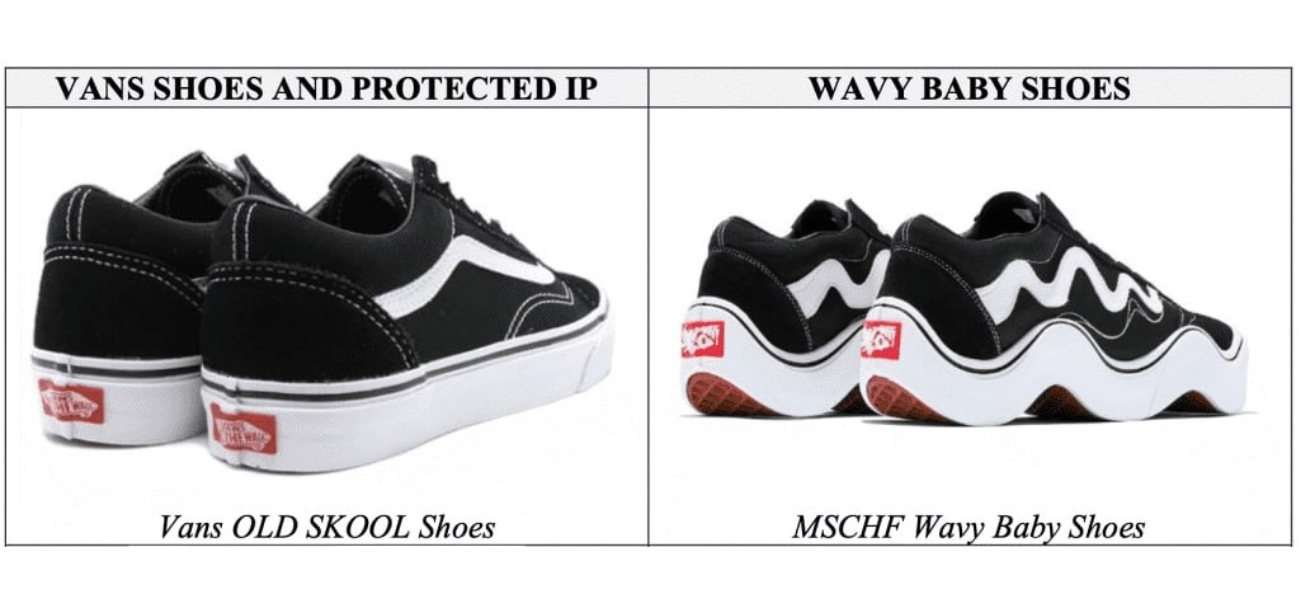
Source: Vans, Inc. v. MSCHF Product Studio, Inc., No. 22-1006 (2d Cir. 2023)
MSCHF believed they were not infringing trademark rights and that their actions met all the requirements of "fair use." They insisted that "Wavy Baby" was a kind of "slap in the face of public taste." Vans Old Skool sneakers are "the perfect embodiment of the dichotomy between an elite and a mass-market product," which is why they were chosen as the object of parody. According to the defendant, society's need for free expression of ideas and thoughts — guaranteed in the U.S. by the First Amendment — should prevail over intellectual property rights.
The court remained unmoved, ruling that MSCHF was required to stop its unlawful use of Vans' trademarks.
As it later became known, the parties ultimately resolved their dispute through a settlement agreement, under which MSCHF acknowledged the unlawful use of Vans' trademark and agreed to stop selling "Wavy Baby" products in any form and to recall the disputed products from all stores5.
Significance of the Case for Legal Practice
This case is notable primarily because it is the first since the famous Jack Daniel's Properties, Inc. v. VIP Products LLC case6, in which the U.S. Supreme Court emphasized that a defendant's use of someone else's trademark as a designation for its own goods — even if done in a parodic or critical manner, as provided for under fair use law7 — constitutes infringement of the exclusive trademark right.
Consequently, case law on so-called "creative use" of trademarks without the rights holder's consent — which is still in the process of forming — is currently not developing in the defendants' favor.
That said, one can still attempt to argue against the court by invoking the fair use doctrine, citing a couple of well-known cases such as New Kids on the Block v. News America Pub., Inc.8 or Mattel Inc. v. Walking Mountain Productions9. However, courts must now more carefully analyze the brand's "goodwill" and precisely how and for what purposes that goodwill is being used.
If consumers form an associative link between the defendant's disputed goods and the rights holder's goods, such use has almost no chance of being recognized as creative interpretation, critical commentary, or parody. This is because, in such a case, the rights holder's goodwill — into which it has invested significant financial and other resources — is also placed at risk. In other words, one cannot free-ride on someone else's reputation by invoking fair use.
Thus, the trademark owner still holds broad monopoly rights and can block virtually any use of its trademark. However, the fact that more disputes of this kind have begun appearing in the courts may signal that the situation will soon change.
How to Find the Boundaries of Trade Mark Rights?
It is well known that trademarks, like other intellectual property objects, have certain — though not always obvious — substantive boundaries, that is, restrictive barriers beyond which the rights holder's exclusive control ceases. The existence, for example, of the institution of "free use" of the results of intellectual activity in Russia (for copyright and patent rights) and of the "fair use" doctrine in the U.S. is justified by society's need for cultural enrichment and basic education.
However, means of individualization — trademarks10 in particular — primarily serve the needs of commerce. Cases of their free use depend on the utilitarian function of the trademark: to serve as an identifier of the source of origin of a good, with which potential consumers associate certain expectations and perceptions about the quality and other characteristics of the product. It logically follows that, compared to copyright and patent objects, there are significantly fewer cases of free use.
In Russia, using a trademark for descriptive, informational, or other purposes unrelated to individualizing goods, works, or services is not considered a violation of trademark rights. Both lawmakers11 and the courts12 hold this position.
Parodic use of someone else's trademark, however, is very unlikely to be regarded by a Russian court as falling under the above exception and thus not constituting infringement of the rights holder's rights.
Although, in our view, this approach does not fully reflect the multifaceted nature of trademarks. Trademarks are not simply a utilitarian tool for labeling products. They can often influence public sentiment, become symbols of an era or of certain phenomena, and serve as a means of expressing particular positions, thoughts, and views13. In such cases, a ban on parodic use of someone else's trademark restricts freedom of speech and self-expression.
Disputes in Russian courts over the use of others' trademarks in works of art without the rights holder's consent are currently extremely rare, which in turn indicates the absence of sufficient legal "groundwork" for courts to apply. The court's conclusions in the case of LOUIS VUITTON MALLETIER v. OJSC "Nidan Soki" 14(a juice manufacturer) appear highly contradictory. In the advertisement, a woman drinking the advertised juice and in no hurry is contrasted with a comically nervous passenger with huge Louis Vuitton suitcases, frantically stuffing them into a car. The court found that the stylized flower design used to mark the suitcases and women's handbag shown in the juice advertisement was confusingly similar to the stylized flower figurative trademark belonging to LOUIS VUITTON MALLETIER.
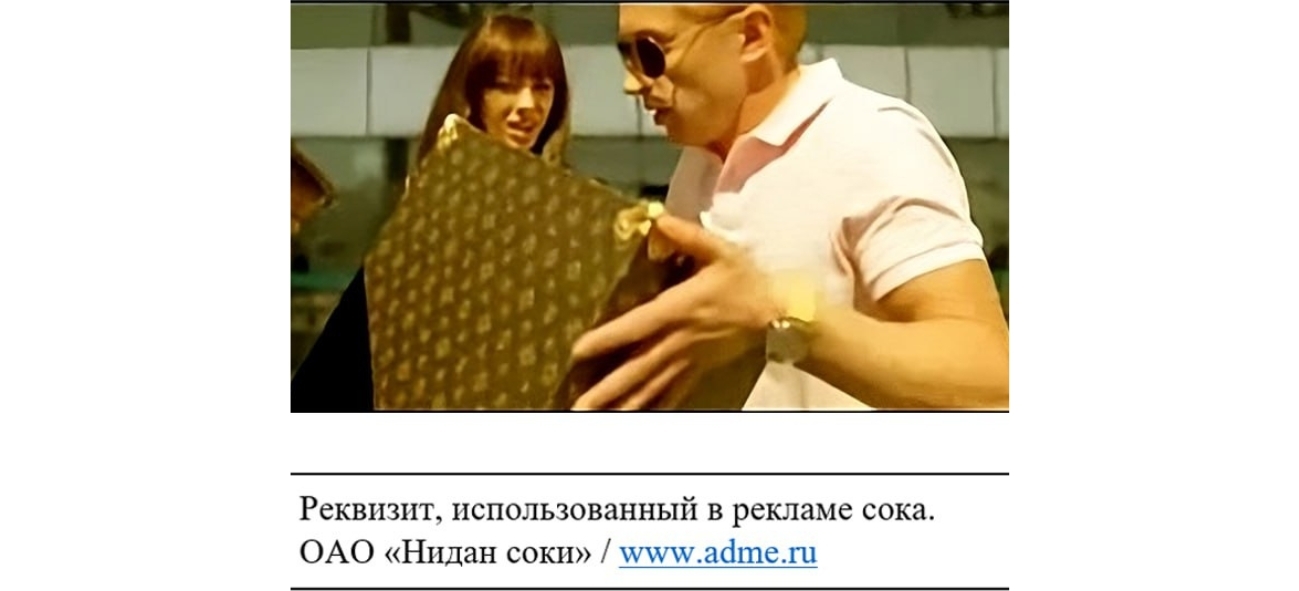
Remarkably, however, the court in this case did not consider at all the nature of the use of the fashion house's trademark. Was the juice manufacturer hoping to draw attention to its product by free-riding on the reputation of a world-famous fashion brand? Or was its purpose primarily parodic? Unfortunately, the judges gave no due consideration to these factors, limiting themselves to a more formal application of the law and ordering OJSC "Nidan Soki" to stop its unlawful use of designations belonging to LOUIS VUITTON MALLETIER.
Today, using someone else's trademarks — or designations confusingly similar to them — and hoping for protection by invoking their parodic nature is a rather risky strategy, both in Russia and in the U.S.
The case of Vans, Inc. v. MSCHF Product Studio has become something of a turning point in the long-running search — by both scholars and practitioners — for answers on the lawfulness of using trademarks for parodic and critical purposes without the rights holder's consent. Although the boundaries of "freedom of self-expression" remain blurred, the emergence of case law on this issue demonstrates the relevance of the problem — and shows that courts are trying to find the boundary of the trademark holder's monopoly, especially in ambiguous cases where it is difficult to determine whether something is creative self-expression or, in fact, an infringement of exclusive rights.
References:
- Alekseychuk, A. "Free Use of a Trademark" / A. Alekseychuk // Intellectual Property. Industrial Property. – 2020. – No. 12. – pp. 53–59. – EDN SUJGXI.
- Vorozhevich, A. S. "Unfair Competition or Abuse of Right in Trademark Registration: Problems of Qualification and Means of Protection" / A. S. Vorozhevich, N. V. Kozlova // Lex Russica. – 2017. – No. 5(126). – pp. 70–82. – DOI 10.17803/1729-5920.2017.126.5.070-082. – EDN YSQRHR.
- Bakhtiozina, A. T. "Freedom of Creativity Against Luxury Brands" // Fashion Law Russia / [Electronic resource] URL: https://fashion-law.ru/post/freedom-of-speech-and-fashion (accessed: 10.06.2024).
- Zuykov, S. A. "'Free Use' of Trademarks" / S. A. Zuykov // Copyright. Bulletin of the Russian Academy of Intellectual Property and the Russian Copyright Society. – 2022. – No. 2. – pp. 52–61. – EDN XPWSLK.
- Intellectual Property Law. Means of Individualization: Textbook, in 3 vols., Vol. 3 / ed. L. A. Novoselova. Moscow: Statut, 2018. 266 p.
Footnotes:
- Vans, Inc. v. MSCHF Product Studio, Inc., No. 22-1006 (2d Cir. 2023).
- Vans, Inc. v. MSCHF Product Studio, Inc., 602 F. Supp. 3d 358, 368, 371–73 (E.D.N.Y. 2022).
- Russian consumers know this company for its "Big Red Boot," which became a genuine internet trend.
- It is worth noting that the collective's works — or, as stated in the court decision, "manifestos" — have been displayed at major venues such as Art Basel, the Perrotin gallery, and the London Design Museum. This naturally leads to the conclusion that the brand and its distinctive approach are recognizable among consumers.
- "Vans and MSCHF Settle Lawsuit Over Infringing Wavy Baby Sneakers." The Fashion Law / [Electronic resource] URL: https://www.thefashionlaw.com/vans-mschf-settle-lawsuit-over-infringing-wavy-baby-sneakers/ (accessed: 31.08.2024).
- Jack Daniel's Properties, Inc. v. VIP Products LLC, 599 U.S. ___ (2023).
- This refers to § 1125(c)(3)(A)(ii) of the Lanham Act, which establishes the lawful borrowing of trademarks in specified circumstances.
- New Kids on the Block v. News America Pub., Inc., 971 F.2d 302 (9th Cir. 1992).
- Mattel Inc. v. Walking Mountain Productions, 353 F.3d 792 (9th Cir. 2003).
- In addition to trademarks used to designate the goods of a particular person, means of individualization also include service marks, which identify works or services. In this analysis, we focused in more detail on the first category.
- See Paragraph 3, Article 1484, Part Four of the Civil Code of the Russian Federation of December 18, 2006, No. 230-FZ (as amended January 30, 2024).
- For example: Paragraph 157 of Resolution No. 10 of the Plenum of the Supreme Court of the Russian Federation of April 23, 2019, "On the Application of Part Four of the Civil Code of the Russian Federation"; Resolution of the Intellectual Property Rights Court of September 30, 2019, No. S01-852/2019 in case No. A40-266746/2018; Resolution of the Intellectual Property Rights Court of April 10, 2024, No. S01-443/2024 in case No. A65-700/2023.
- For more on when the trademarks of well-known brands, including in the fashion industry, have become the subject of biting satire, see A. T. Bakhtiozina, "Freedom of Creativity Against Luxury Brands" / [Electronic resource] URL: https://fashion-law.ru/post/freedom-of-speech-and-fashion (accessed: 10.06.2024).
- Resolution of the Tenth Arbitration Court of Appeal of March 19, 2009, in case No. A41-5137/08.